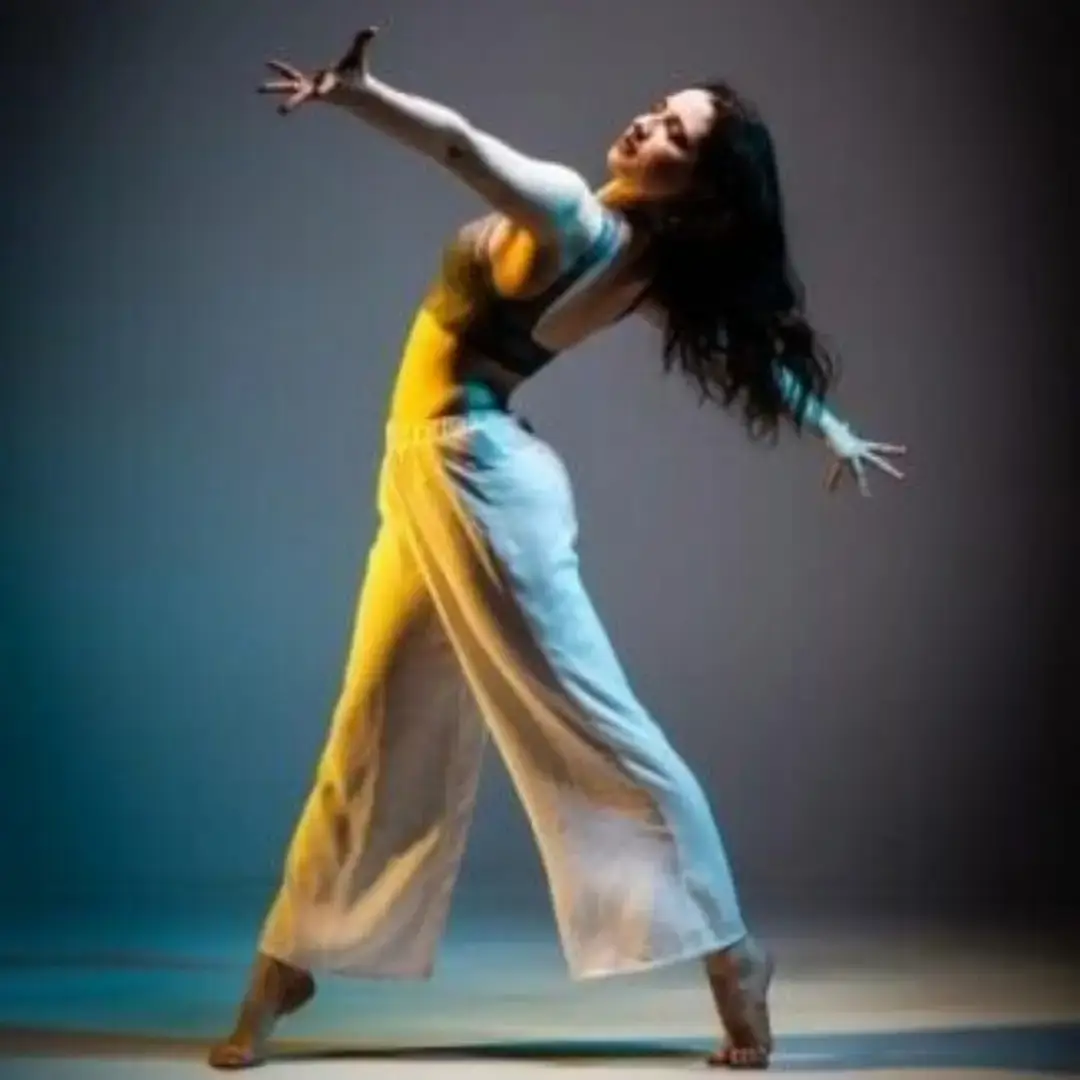
Odissi Dance: History, Origin, Techniques
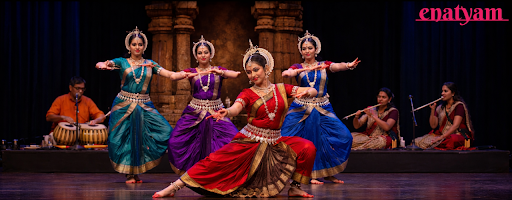
Odissi dance is an ancient and exquisite Indian classical dance form, started in the Odisha temples and you can still feel that history every time you watch an Odissi performance. The origin of Odissi traces its roots to temple rituals and devotional practices, which makes the history of Odissi dance deeply connected to spirituality. This Odissi classical dance form is one of the 8 classical dance traditions of the country and it is deeply rooted in spirituality, music, sculpture, and literature. What makes Odissi dance special is its flowing movements, the poses that look like sculptures, the way it tells stories and its deep connection to the traditions of worshiping god. Odissi is a dance form that is very elegant and it has a lot of meanings.
Odisha, which was previously known as Kalinga, is one of India’s ancient civilizations, excelling in cultural, architectural, and artistic achievements. Ancient stone temples and carvings in Bhubaneswar, Puri, and Konark provide visual information about Odissi dance and its early evolution.
The stone sculptures of Konark, for instance, capture dancers in postures of movement and expression, demonstrating what is more than decoration, but an expression of art, architecture, and culture in Odissi's early forms. The sculptured dancers embody the great cultural and artistic depth of the civilization of the time, even as they narrate through their soft and serene movements the tales of divinity, devotion, and the myriad of human experiences.
Odissi dance is known for its fluid torso movements, detailed foot work, expressive eye work, and precise hand gestures. Each movement is a choice, each pose a symbol. It was first presented as a devotional dance in temples, since then, it has been through many changes.
From temple practices to royal court performances, through the down fall during colonial rule to the renaissance in the present time, Odissi history reflects resilience and today it is a global icon of India’s art heritage.
Historical Evolution of Odissi
Mythological and Ancient Origins
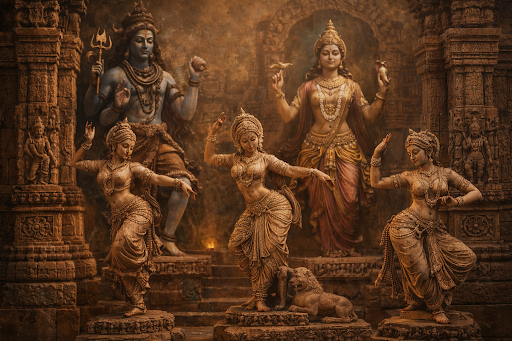
Like other classical Indian dance forms, Odissi dance history begins in mythology. According to Indian tradition, dance originated in the celestial realm and was brought to earth by divine beings. Lord Siva's tandav (his cosmic dance of destruction) and Lord Vishnu's gracious Mohini form are thought to be the earliest sources of classical movement vocabularies.
The earliest mention of dancing is found in the Rig-Veda: around 1500 BCE. The term 'nritya' is mentioned there. Dance was thought of as a thing that Gandharvas and Apsaras did, musicians and dancers who entertained the gods with their performances. These beings were noted for their elegance of movement, musicality, and skills in storytelling.
The first real rules for Indian performing arts show up in the Natyashastra,written by Bharat Muni sometime between 500 BCE and 500 CE. This old text set out how dance, drama, and music should work. In particular, Odissi gets its structure from something called the Odra-Magadhi Pravritti, one of the four regional styles the Natyashastra describes, and it’s tied closely to the Odisha region.
There’s also hard proof that Odissi’s roots run deep. If you look at the Hathigumpha inscription in the Udayagiri caves, or the temple sculptures at Konark and the reliefs in Bhubaneswar, you’ll see dance poses that go all the way back to the 2nd century BCE. These are the same postures you find in Odissi today.
Temple Tradition and the Mahari System
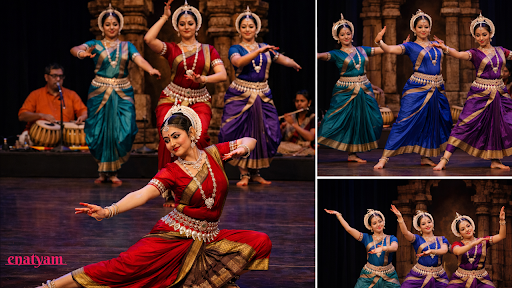
During its primitive historical period, Odissi was chiefly performed by Maharis or female temple dancers, who were dedicated to the service of the deities. They were not entertainers in the contemporary sense, but ritual performers who expressed their devotion. Their performances were described as sacred offerings and referred to as seva.
Some Maharis were even highly trained in music, literature, aesthetics, and dance. For generations, they retained within the family the repertoire, compositions and performative nuances of the Odissi tradition. They embodied elegance, wherein their sensuality was felt more than it was seen, their movements were subdued yet definitive, and their emotion was intense yet hidden in plain sight.
Alongside that of the Mahari tradition was the Gotipua tradition. The Gotipuas were boys wearing the clothes of female dancers who performed outside temples in festivals and during social gathering times. They brought a dynamic and acrobatic nature into Odissi using Bandha Nrutya, which involves many formations of the body.
Some of the greatest Odissi gurus of the 20th century, including Kelucharan Mohapatra and Deba Prasad Das, received their original dance training as young children in the Gotipua tradition.
2. Kathak as a Temple Dance
In its earliest form, Kathak was performed in temples, where it became a devotional art form dedicated to narrating stories from Hindu mythology. These performances incorporated graceful movements and intricate footwork to dramatize spiritual themes and epic tales. The temple setting fostered the growth of Kathak as a sacred dance, blending storytelling with classical techniques and religious devotion.
Medieval
Between the 11th and the 15th century, Odisha flourished under the Ganga dynasty, where the leaders were great patrons of the art and culture world. It was at this period that Odissi gained royal support and traditions of dances of the temples were well maintained and advanced.
Some of the best examples of visual records of the Odissi technique are sculptures ordered by Ganga rulers to the Sun Temple at Konark, and the Jagannath Temple in Puri. They portray tribhangi poses, hand-poses, and body language which are the same as today.
The period was also characterized by recording the knowledge of dance. The Abhinaya Chandrika by Maheshvara Mahapatra is one of the treatises that present body movements, gestures, postures, and expressive principles.
Odissi was severely influenced by the Bhakti movement. Vaishnavism took the stage and songs with themes of Krishna, Radha and divine love took precedence in the programmes. The Gita Govinda of Jayadeva became one of the greatest literary references to Odissi choreography and music.
Modern Era
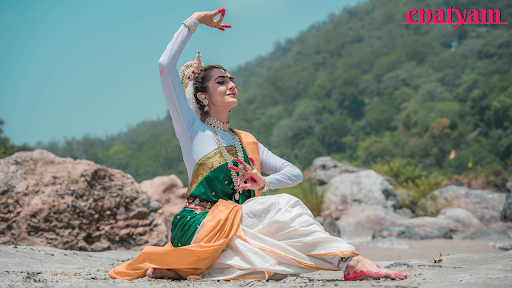
The contemporary period of Odissi is characterized by the period of strength, rediscovery, and change. Odissi may have lost all of its substance to foreign invasions and colonial oppression after centuries of degradation, had it not been that a strong revival movement emerged in the middle of the 20 th century. It was not a time when a dying dance form was saved. It redefined Odissi into a teachable, classical art and a globally recognized and respected one at that.
Cultural Reawakening in a Post-Independence.
India received its independence in 1947 and the awakening regarding the need to preserve cultural heritage in India was experienced nationwide. Artists, scholars, and leaders of the culture realized that rich traditions in India had to be rebuilt, recorded and disseminated. The rebirth of Odissi did not happen by chance. It belonged to a premeditated cultural campaign with the help of enlightened intellectuals and territorial pride and institutional endorsement.
Odissi masters and teachers started to scramble among the remnants of their tradition, sculptures, carvings at the temples, pieces of oral tradition, here and there manuscripts. This was painstaking work. No manuals were complete to be followed. Academies were not yet in existence. All that was needed to be rebuilt using historical hints and recollection.
The Gurus That Redefined Odissi
A number of innovative artists became pioneers during this era. They were not mere actors, they were scholars, dance designers, educators and cultural representatives.
● Guru Pankaj Charan Das was also extensively engaged in oral traditions and Gotipua practices. He assisted in creating a systematic curriculum and syllabus.
● Guru Kelucharan Mohapatra was a giant as he combined the temple aesthetics with the modern performance requirements. His teaching techniques changed Odissi in village and temple art into a disciplined form of art on the stage.
● Guru Deba Prasad Das introduced a sculptural simplicity to the movement by direct inspiration from stone carvings and patterns of rhythm.
● Guru Mayadhar Raut brought up the fine techniques of choreography and assisted Odissi to interact with the contemporary world without distorting the character.
These were not the only artists who were teachers. They were pioneers who thought that Odissi could be placed at the same level as Bharatanatyam, Kathak and other classical dances among other forms as a living and breathing art, and not as a relic.
From Temples to Institutions
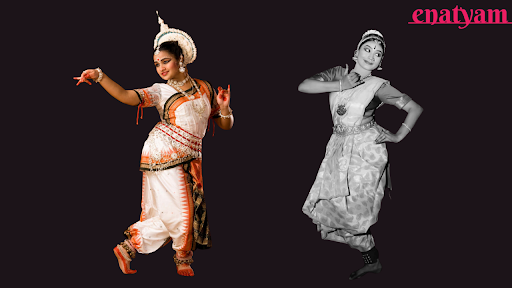
Formation of institutions was one of the most significant changes that were experienced in the modern era. Gurus started teaching in organized places and not the informal or communal places. Bhubaneswar and Cuttack were the birthplaces of dance academies that were established later in India. This was paramount as it enabled the art to have documentation, standardization and transmission.
Research centres such as the Odissi Research Centre established by Guru Kelucharan Mohapatra became a centre in which technique, history, music and choreography were studied in depth. These schools made a significant contribution to the development of a curriculum that was teachable across the generations.
As India started to be much more proud of its cultural heritage, Odissi acquired an opportunity on the national stages, on television shows, and at cultural festivals. The recognition of the Odissi teachers and performers as respectable cultural figures was assisted by the significance of such awards as Padma Shri, Sangeet Natak Akademi awards, and state awards.
International tours have been popular since the 1970s. Odissi dancers started to dance in Europe, North America, Asia and other places. What used to be a temple ceremony turned out to be an image of Indian cultural superiority in the global arena. Those who had never heard about Odisha also started relating the region to this beautiful dance.
The ability of Odissi to remain classical yet transforming with the contemporary times is one of the most impressive strengths of the modern age. The modern choreographers address new topics including social justice, human emotion, environmental concerns and remain loyal to the main principles of rhythm, expression and spiritual intent. This tradition-innovation mix has provided Odissi with living relevance in the 21st century.
Key Principles and Techniques of Odissi Dance
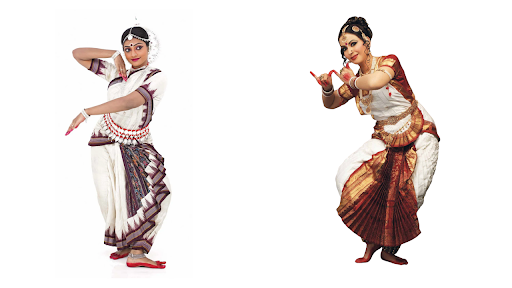
Odissi is not simply a series of steps. It is an extremely well-defined body consciousness, rhythm, emotion, and narrative. It speaks with a physical language, but is very expressive. Four main principles of Odissi at the core of Odissi are easily identifiable: elegance, balance, delicate articulation, and emotionality.
The significant elements which we divide into comprising the technical basis of Odissi are listed below.
1. Tribhangi
In Odissi, the term Bhangas is used to refer to how the body bends and lines up with the head, torso and hips. These body postures are categorized into three central types, namely, Samabhanga (straight), Dvibhanga (two bends), and Tribhangi (three bends). Of which, Tribhangi stands out as the most significant and characteristic pose of Odissi.
The body of the dancer in the Tribhangi pose is subdivided into three parts including the head, upper body and lower body. The individual sections bow out to each other in a mild S-form. This pose is what makes Odissi have its typical graceful and sculptural appearance. The traditional Odissi terms for this pose are also Natavara Bhangi, which is based on a graceful pose of Lord Krishna.
2. Bandha Nrutya
Bandha are manipulated and even acrobatic postures which are the result of the Gotipua tradition, in which young male dancers used their bodies in physically challenging poses. These are postures that entail the creation of exact shapes of the body, emphasis being on balance, symmetry, and stability.
Bandha Nrutya involves good core strength and total coordination of the limbs, lower body and the upper body. These poses need to be well maintained and clear to the dancer without being ungrateful. Odissi has some famous Bandhas, such as Bhumi Bandha (grounded pose), Janu Bandha (knee-based pose) and Hasta Bandha (hand-based pose). These roles underscore physical punishment as well as artistic domination of the dancer.
3. Pada Bheda
Footwork in Odissi is also called Pada Bheda, where pada translates to feet and bheda translates to variations. Pada Bheda is the rhythmic basis of the dance and contributes a big portion to the establishment of fluid movement and balance.
It has 46 accepted foot positions in Odissi that have a particular role and design. Such variations of feet enable the dancer to move comfortably around the dance floor without losing touch withthe rhythm and music. Sama, Sthana, Apluta, Bhramari, Ekpada Bhramari, Chauka, Alidha and Pherei are some key Pada Bhedas. The combination of these two forms the graceful and earthly style of movement which is synonymous with Odissi.
4. Hasta Mudra
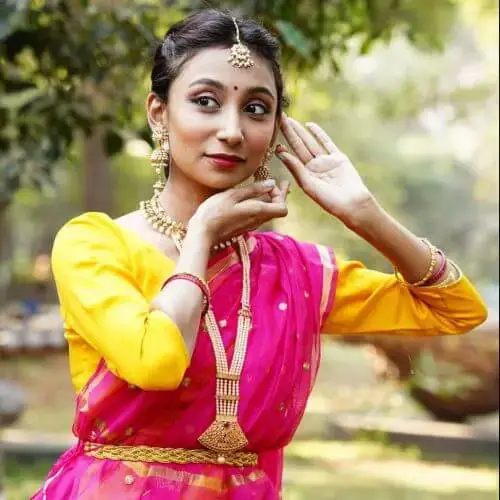
The use of hands is also a crucial part of Odissi which is called Hasta Mudras that help express the meaning and tell a story. These signs combine with facial expressions and body language to complement the expression of feelings, character, objects, and scenarios.
Odissi Hasta Mudras are of four broad categories:
● Asamyukta Hasta Mudras: 28 single-hand gestures.
● Samyukta Hasta Mudra:s 23 kinds of two-hand gestures.
● Nrutya Hasta Mudras: 17 postures applied primarily in pure dance sequences.
● Parampara Hasta Mudras: 10 traditional gestures that are transferred between generations.
All gestures possess certain symbolic value and assist to convert physical movement into the language of expression.
5. Abhinaya
Abhinaya refers to the art of expression and it is the emotional essence of Odissi. It is a combination of all the aspects of the dance including body movement, facial expression, footwork and hand movements to express emotions and narratives.
Dancers depict the Navarasas, or nine basic emotions with the help of Abhinaya: love (Shringara), joy (Hasya), anger (Raudra), compassion (Karuna), fear (Bhayanaka), disgust (Vibhatsa), surprise (Adbhuta), peace (Shanta), and heroism (Veera).
The ability of a dancer in Abhinaya indicates that he or she really masters Odissi. It enables them to relate well with the audience and make the performance emotionally touching and unforgettable.
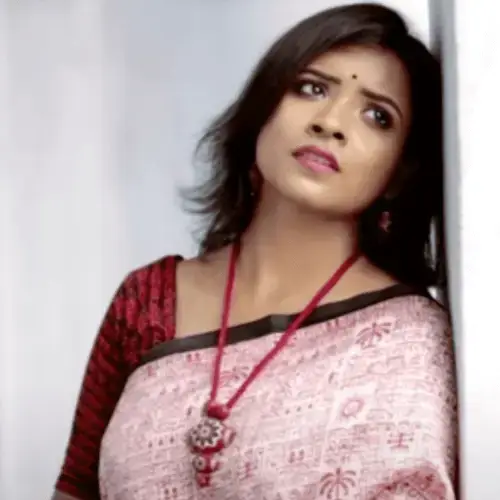
In Odissi, the whole body comes to play as a tool of expression. The torso, arms, spine and posture all work together in order to convey meaning. Facial expression is an important part, particularly with regard to the eyes, eyebrows, forehead, nose, cheeks and chin. The face is used in every part consciously to show the emotions and to promote the narrative, which makes the performance rich, subtle and powerful.
Traditional Odissi Costume and Makeup
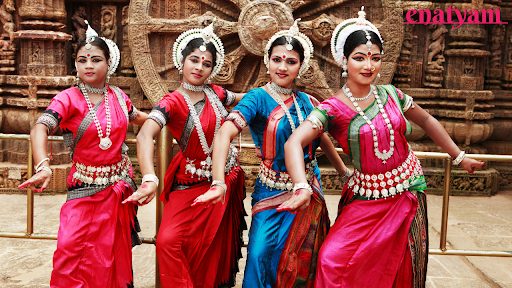
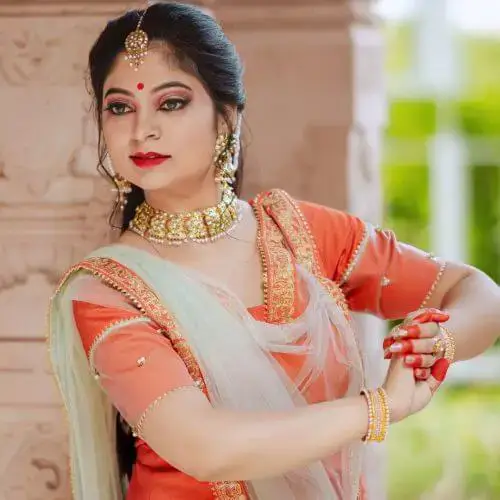
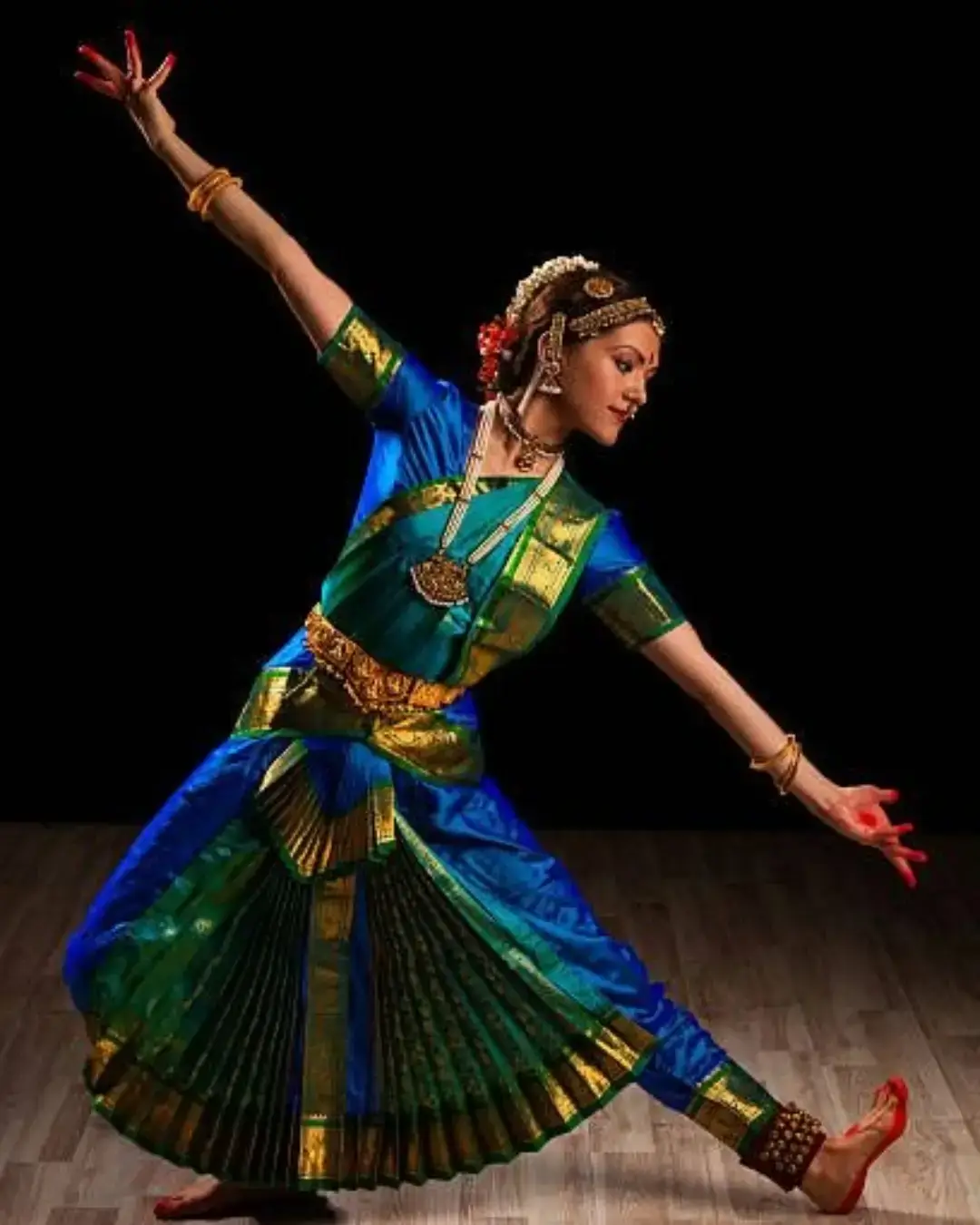
The Odissi traditional costume is a visual spectacle and contributes significantly to the overall performance attractiveness. The costume represents the cultural background and aesthetic values of Odisha with its rich colors, detailed design of dressing, and other ornamental features. Not only does it render the dancer elegant, but it also aids in telling a story by improving expressions, movements, and presence on the stage.
Attire
The costumes of Odissi are very bright and luminous and are meant to match the elegant motions of the dance. The female dancers are also dressed in sarees and the male dancers are dressed in dhotis just like many styles of Indian classics.
Special wear of silk sarees by female dancers is known as Nivist style, and it includes several pleats and folds, along with tucking. This provides a flowing but ordered appearance which makes it move freely and at the same time elegant. Male dancers also wear a dhoti knotted around the waistline with pleats hanging at the front. Their high body is still naked and they normally have a scarf called uttariya, which they wear directly over the neck, put across the chest and tied in at the waist. These costumes are made so as to be comfortable and yet beautiful to the eye.
Ornaments
The Odissi costume consists of jewelry, which gives the dancer an appealing look. Both female and male dancers are dressed with traditional ornaments which emphasize on body movements and facial expressions.
Women dancers have necklaces, huge earrings, bangles and armlets. The most prominent of these is the mukut, the headpiece of the decorative flowers of white color that is worn around the bun of hair. This is accompanied by a mangtika on the forehead. Ankle bells, known as ghungroos, are tied around the waist to complete the look and a silver or gold waist belt called mekhala is tied around the waist.
Makeup
In Odissi, makeup is maintained so as to bring out the facial aspects since expression is an important aspect of this dance. Having emotions on the face, every detail of the face should be clear to the audience to decode the story.
Eyes have a heavy eyeliner to enhance the expression of the eyes. Eyebrows are also darkened and shaped and lips are painted in bright red and a red bindi is put on the forehead. Traditional decorative works using sandalwood paste are also common in order to embellish the traditional design.
Male dancers apply less makeup and jewellery. Their appearance is maintained low-key where more emphasis is made on the natural look and characterization over being overly decorated.
Online Odissi Classes and Learning Opportunities
Dance enthusiasts can now explore online dance classes and online Odissi classes to learn this timeless art form from experts. These classes make it accessible to students worldwide, preserving India’s classical heritage while adapting to modern learning methods.
Conclusion
Odissi is a classical dance that has existed since ancient times and is a perfect representation of Indian culture, spirituality, and the beauty of art. It is based on the traditions of the temples and is formed through devotion and hard work, and has become a sophisticated form of performance art that is recognized all over the globe.
Odissi with its beautiful movements, dramatic narration and deep symbolism, still helps to bridge the gap between the ancient and modern generations. This is due to the work of visionary gurus and practitioners who have made sure that this dance form is still living.
FAQs about Odissi Dance
Who invented the Odissi dance?
Odissi dance developed throughout centuries in the tradition of temples in Odisha. But during the 20th century, Odissi was revived and shaped by a group of legendary gurus. These were Guru Kelucharan Mohapatra, Guru Pankaj Charan Das, Guru Debaprasad Das and Mayadhar Raut. Guru Kelucharan Mohapatra is particularly remembered who brought Odissi to the international scene and popularized it in the whole world.
Which state dance is Odissi?
The Odissi dance is the traditional dance of Odisha (formerly, Orissa) found on the eastern coast of India. It originated in old temples and is characterized by smooth movement, elaboration of footwork and the so-called tribhangi position, when the body is bent in three dimensions, as the sculptures in temples like the Sun Temple of Konark seem to be.
Who is the father of Odissi?
Guru Mayadhar Raut is the Father of Odissi Dance who is greatly respected. He did a great job in reviving and developing Odissi into a decent classical dance style in the 1950s by providing it with a solid base as per the traditional dance texts. Other significant aspects such as expressive feelings and hand gesture techniques were introduced by him. Meanwhile, Guru Pankaj Charan Das is recalled as the 20th Guru, or the one who kept the older form of temple, Odissi.