January 4, 2026

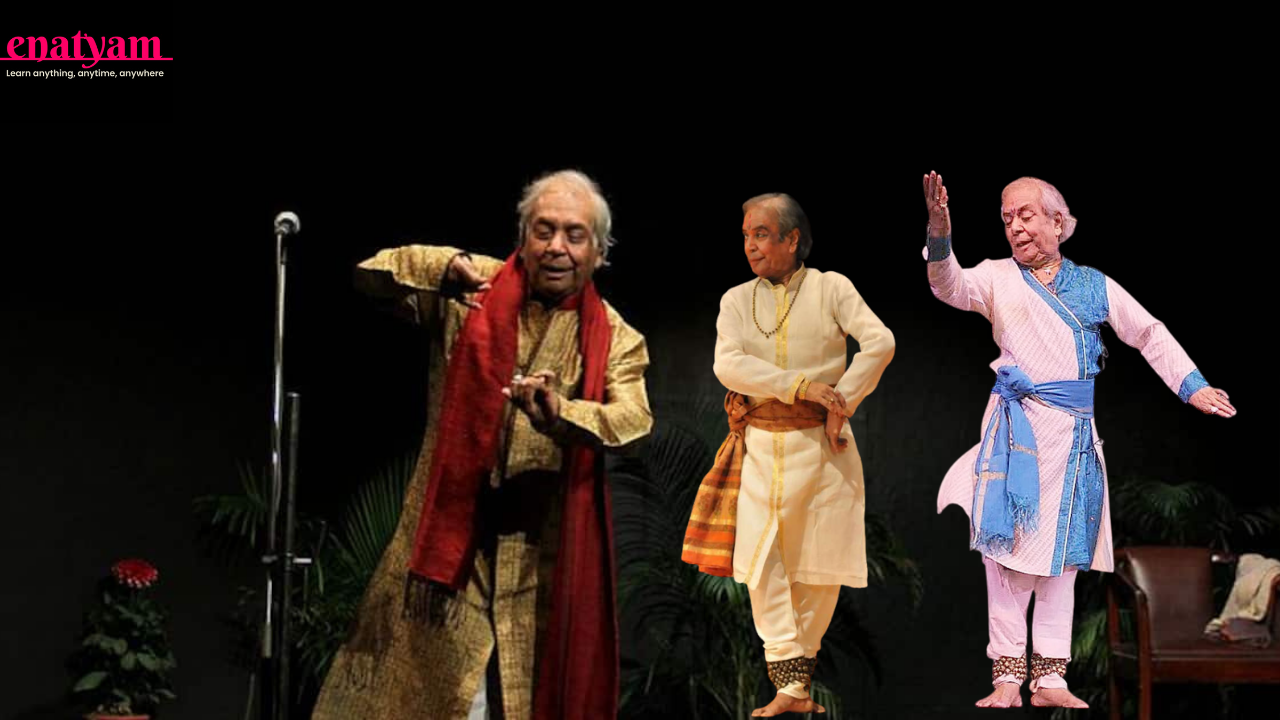
“Art will never betray you, it will leave you only at death” – Pandit Birju Maharaj
Pandit Birju Maharaj was a legendary artist who made history with his Kathak performances. So much so, that his name and Kathak are pretty much inseparable. For seventy years, he didn’t just perform Kathak, he lived it, taught it, and brought it to people all around the world. Any discussion about Birju Maharaj instantly becomes a discussion about Kathak itself.
People admired him for more than just his incredible footwork or sense of rhythm. He had this way of telling stories through movement that could hold you spellbound. His journey wasn’t really about collecting awards or applause. It was about discipline, years of hard work, and a real love for his art.
He once said,
“Every dancer must strive for perfection, but it is the imperfections that make the dance truly unique and human”.
He still inspires dance everywhere and learning more about Birju Maharaj proves that true brilliance in classical art comes from real sincerity.
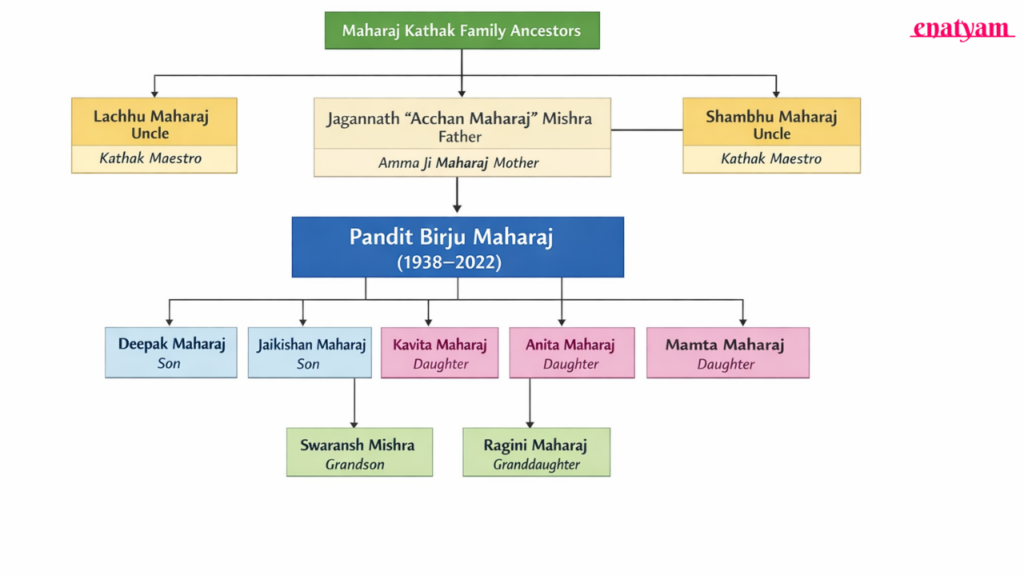
Born on 4 February, 1938, Pandit Birju Maharaj’s birth name was “Brijmohan Nath Mishra” (initially named Dukh Haran). He was born into the legendary Lucknow tradition of Kathak, widely known as the Birju Maharaj gharana, formally referred to as the “Kalka-Bindadin” Gharana. His father, Achhan Maharaj and his uncle Shambhu Maharaj and Lachhu Maharaj were all well known Kathak dancers. Growing up in an environment surrounded by music and rhythm, he learned Kathak at a very young age.
Over time, he became one of the most influential male Kathak dancers. Pt. Birju Maharaj was known for his elegance, detailed footwork and his own creativity in Kathak dance. Besides being a wonderful classical Kathak dancer, Birju Maharaj was a wonderful singer with a strong hold over Thumri, Dadra, Ghazals and Bhajan.
He was not only a Kathak dancer but also a choreographer and poet. When he was 13 years old, Sangeet Bharati invited him to Delhi to teach multiple students.
Birju Maharaj started his learning in Kathak almost as soon as he could talk and he gave his first stage performance when he was 7 years old. When he started his early training, he completely focused on strong basics like foot tapping, rhythm, balance and expression. The emphasis was always on building a strong understanding of Taal and the emotions behind every movement.
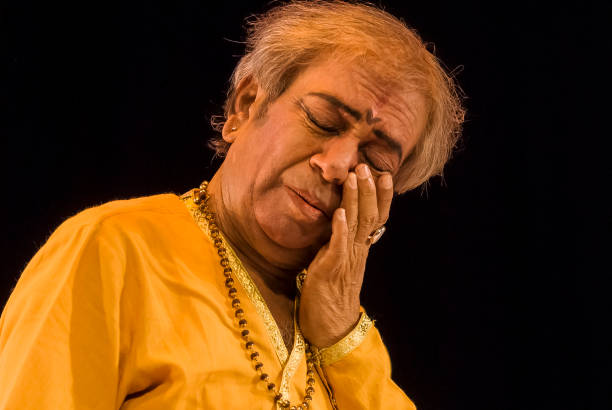
Birju Maharaj saw his father’s death at a very young age and it brought him emotional and financial difficulties. This phase tested him deeply. However, instead of feeling broken, these challenges strengthened his commitment to dance. He took further guidance from his uncles and continued his training with even greater dedication.
Even as a teenager, you could see he wasn’t just another student. His command of rhythm, his sharp footwork, and the way he brought stories to life, he just stood up.
Birju Maharaj’s big break came when the famous filmmaker Satyajit Ray noticed him with his exceptional talent. Ray chose him as a dancer and choreographer for the film “Shatranj ke Khilari”. This opportunity became a turning point for Birju Maharaj in his career and it also helped him get recognition and respect.
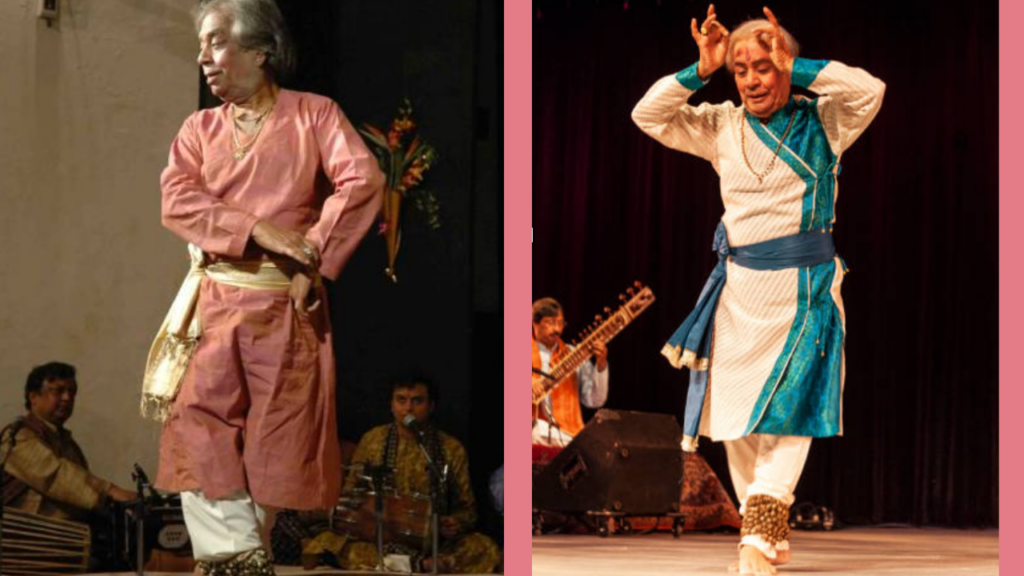
Pandit Birju Maharaj was associated with Kathak Kendra in Delhi. His association was the most important phase of his life. At Kathak Kendra, he helped build a structured and disciplined system for learning the traditions of the Birju Maharaj Gharana.
He believed that the institution should not only produce Kathak performers but also responsible artists who understand the depth of the art form. Then, he started focusing on strong basics, strong basics and a clear understanding of rhythm and expression.
Under Birju Maharaj’s guidance, Kathak Kendra became a respected center for Kathak training and after that it started getting a lot of students from different parts of India and abroad. He gave the institution direction and many dancers who trained there went on to become well known Kathak performers.
After serving many years as a Head of Faculty at Kathak Kendra, he retired in 1998 at the age of 60.
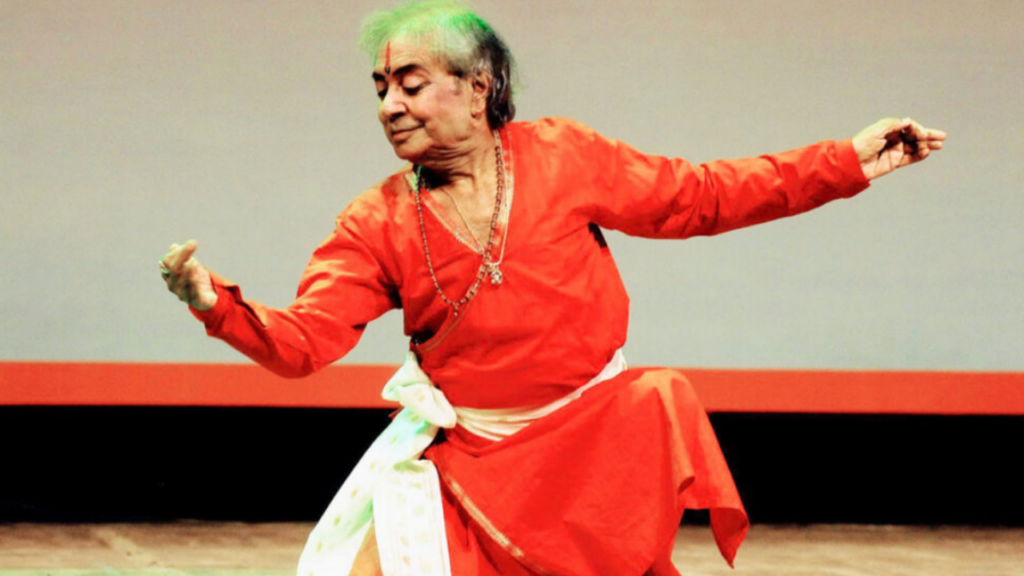
The Kathak dancer Birju Maharaj helped the art form by strengthening its base and expanding its reach. He followed conventional rules but showed that the dance may grow naturally without losing its individuality.
He developed new dance compositions, rhythmic patterns, and presentation techniques that were based on classical training. His work demonstrated that Kathak may portray a wide spectrum of emotions and circumstances beyond legendary stories.
He paid special attention to clarity. Each movement, every expression and pause conveyed meaning. This improved the audience’s understanding of Kathak and made performances more engaging.
Apart from the dance, Pt. Birju Maharaj was also deeply connected to music. He understood classical music and rhythmic patterns that helped him create strong dance compositions.
He composed many rhythmic pieces that are still taught today. Through his work, he showed how closely music and dance are connected in Kathak.
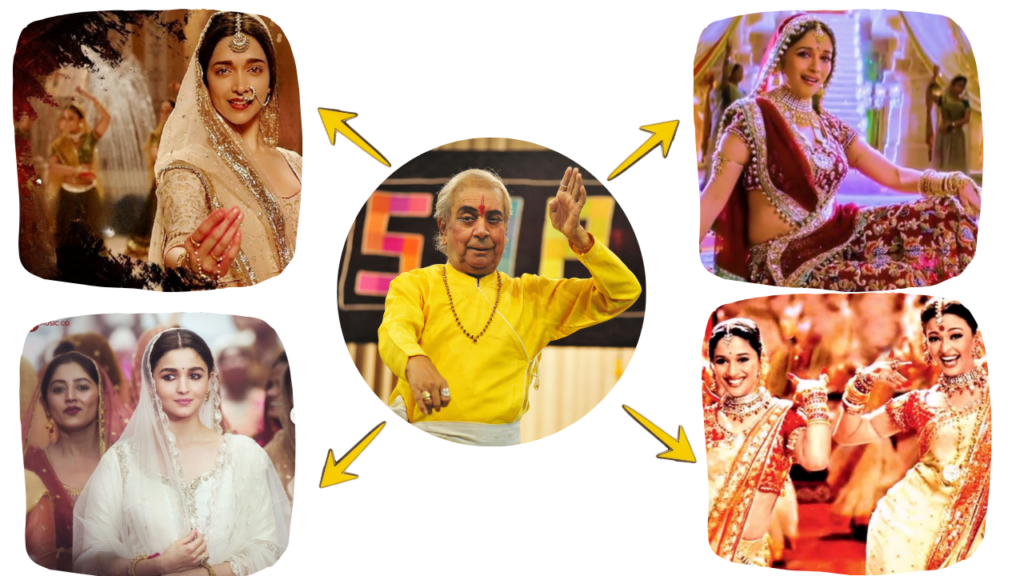
The Birju Maharaj biography is incomplete without mentioning his work in Bollywood. He brought classical dance into cinema and his work can be seen in films like “Devdas” in 2002, “Bajirao Mastani” and “Kalank.”
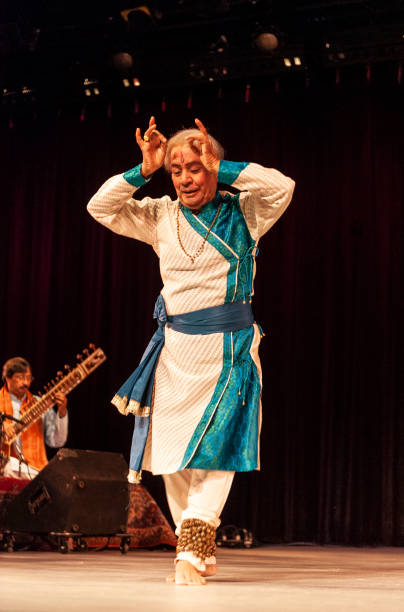
Pandit Birju Maharaj’s journey as a leader in Kathak was gradual. His development was slow and steady as it was based on years of dedication, efforts and thorough comprehension of the dance form.
From the beginning of his career, he focused on mastering the basics of Kathak, particularly footwork and rhythm. It would later become his most powerful performances. His knowledge of intricate rhythmic patterns was extraordinary. He could handle difficult Taals in a very easy way and his movements are always calm and controlled.
Instead of rushing through compositions, he paid attention to time, details, pauses and balance. This made his performances simple and easy to understand, especially for audiences unfamiliar with Kathak.
Kathak dancer Birju Maharaj’s expressions always set him apart. He always believed that dance should communicate emotions honestly. He paid close attention to facial expressions, eye movements, and body language. His abhinaya was subtle and deeply connected to the bols and audience.
As he continued to perform across India, senior artists and audiences started to recognize him. His name slowly became linked with the quality and seriousness in Kathak. Then, he started getting invitations to perform at major festivals and cultural events. Over time, Pt. Birju Maharaj became one of the finest and most famous Kathak dancers of this generation.
Pandit Birju Maharaj was a deeply committed teacher of Kathak. Teaching was always an important part of his life. He always believed that the future of Kathak depended on how honestly and carefully it was passed on to other people and learners.
He wanted to preserve Kathak by teaching it with clarity, discipline and understanding. Later in his career, he became closely involved with Kalashram, where he started to train people who wanted to learn Kathak. In Kalashram, he always encouraged students to think and understand what they were learning.
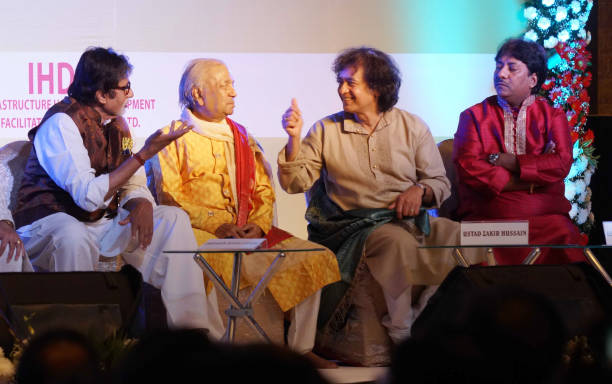
He founded Kalashram (a space dedicated to Kathak and related classical dances only) to continue serious training outside the formal institutions. Kalashram became a place where students could learn in a focused environment with strong attention to rhythm, expressions and regular practice. Here, Birju Maharaj trained multiple students personally and closely and helped them develop a strong base in Kathak.
As a mentor, he was very patient. He taught disciplines like instrumental music, vocal, yoga, painting, Sanskrit, stagecraft dramatics, and sincerity and respect for the Kathak. He believed that a dancer should first understand rhythm and control before moving towards performance.
Pt. Birju Maharaj also guided several well known artists from the film industry. Many famous personalities like Madhuri Dixit, Rani Mukherji and Sushmita Sen learned Kathak under his guidance for their respective roles. His training helped them understand grace, posture and expression in a classical way, which was clearly visible in their performances.
He also trained top dancers and choreographers for Kathak dance steps. He helped renowned Bollywood choreographer Vaibhavi Merchant and renowned Kathak dancer and Padma Bhushan awardee Uma Sharma.
Pt. Birju Maharaj made sure that Kathak continued to develop in a balanced manner with years of mentoring, teaching and institution building.
Pandit Birju Maharaj performed in many countries and introduced Kathak to audiences who had never seen Indian classical dance before. Through his Kathak performances, he became one of the world’s most famous Kathak dancers. He also represented India at major cultural festivals and worked with artists from different traditions. Despite international recognition, he remained grounded and continued to focus on teaching and practice.
Pandit Birju Maharaj’s work made Kathak famous world wide. People from many countries connected with his dance and followed his work with genuine interest. He performed on some of the most respected international stages including the Royal Albert Hall in London and the Kennedy Center in Washington, D.C., where audiences responded with great appreciation.
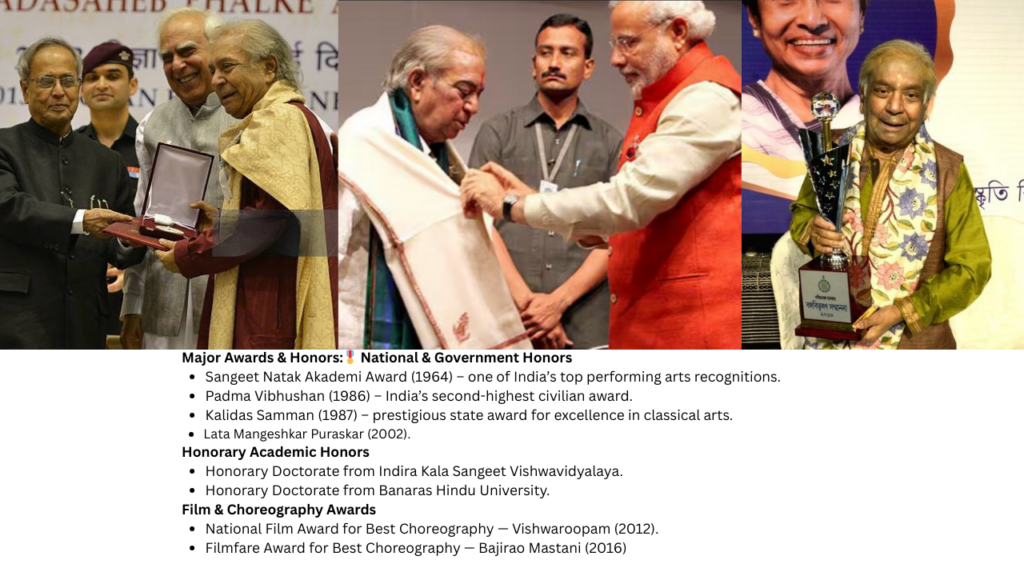
Birju Maharaj’s long and dedicated work in Kathak and Indian performing arts was recognized with several important national awards. These honors were not only for his skill as a dancer, but also for the way he influenced students, audiences and future generations through his commitment to the art.
Some of the major awards and recognitions he received are listed below:
Pandit Birju Maharaj had several personal interests that reflected his curious and active mind. He was especially fond of cars and gadgets. In one of his interviews, he once shared that if dance had not become his path, he might have chosen to work as a mechanic.
Even in later years, he enjoyed taking apart everyday gadgets like television sets and mobile phones, only to put them back together again. He also enjoyed watching films, particularly Hollywood action movies. Jackie Chan and Sylvester Stallone were his favorite actors. These simple interests gave a glimpse into his personality beyond the stage and classroom.
Birju Maharaj was a family man. He had five children – two sons and three daughters. Among them, Deepak Maharaj, Jai Kishan Maharaj and Mamta Maharaj are prominent Kathak dancers.
In his later years, Birju Maharaj slowed down and reduced his stage performances, but he never stopped teaching the artform. He loved guiding students and sharing his knowledge whenever he could. Even when his health wasn’t the best, his connection to Kathak stayed strong.
Birju Maharaj took his last breath on 17 January 2022 in Delhi. His wife had passed away around 15 years before him, a loss that deeply affected him. Regarding the Birju Maharaj death reason, it was reported that he suffered a heart attack at home while playing with his grandson. His death was a major loss for Indian classical arts, but today, his influence lives on through his students, his teachings and the values he passed on to future generations.
He was a true symbol of discipline and dedication, and even to this day, he is referred to as one of the most respected male Kathak dancers.
Pandit Birju Maharaj wasn’t just a legend, he was the soul of Kathak. With every gesture and every beat, he made it all feel alive. He took the old traditions of the Lucknow Gharana and transformed the stage into a pure space, which turned every performance into a story that reached far beyond India.
The awards he received are not really what set him apart, but the students he shaped, the movies he breathed magic into and the way he passed on his love for dance.
Pt. Birju Maharaj was a part of the Kalka-Bindadin tradition, or Lucknow gharana of Kathak. This gharana is renowned for its elegance, narrative, expressive motions and sophisticated sense of rhythm. He was quite sincere in carrying on his heritage.
He was born in the state of Uttar Pradesh, specifically in Handia, Allahabad (now Prayagraj).
Birju Maharaj established the foundation of Kathak. He emphasized significant phrases, powerful rhythm, and unambiguous fundamentals. He developed new and fresh compositions, enhanced instructional strategies, and demonstrated that Kathak can develop without losing its traditional identity.
Yes, he was a choreographer for multiple Bollywood movies. His classical touch is evident in movies like Devdas, Bajirao Mastani, and Kalank. He made Kathak more widely known through films.
He was not just a legendary performer, he was a great teacher, mentor, and guide. He shaped Kathak into something bigger, bringing it to audiences all over the world. He set the bar high for discipline, emotions and honesty in Kathak dance and that is something people are still striving for today.
He taught real patience and made things clear. In Kathak Kendra and Kalashram, he pushed his students to really feel the rhythm, understand emotions, and find balance before stepping on stage. Due to his guidance, a whole generation of dancers grew up with confidence, depth and a true respect for the art.